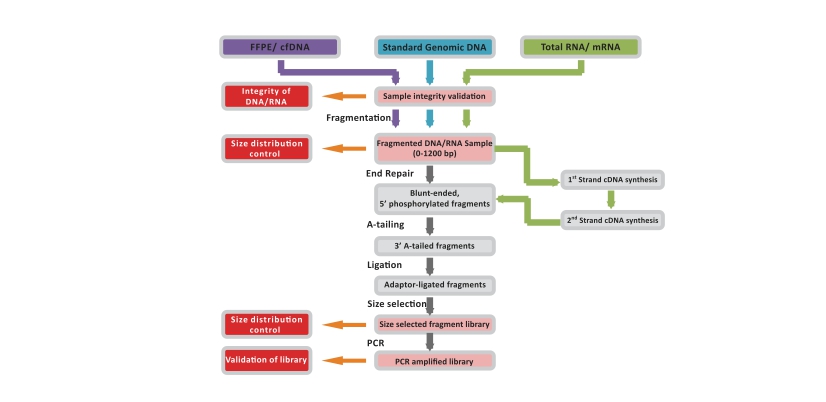
Next Generation Sequencing (NGS) is a widely used technology in many fields, including genomics, epigenetics, transcriptome, etc. NGS is not only used in basic research but also applied for clinical diagnostics such as cancer screening and drug development.
CRISPR is a Genome Engineering technique that uses protein to interact with DNA. Genome editing begins with dsDNA cleavage. Cas9 is a dual-RNA-guided dsDNA endonuclease that is programmed by a single chimeric RNA. The guide RNA positions the Cas9 enzyme to the correct position on the target DNA for cleavage.
Cell-free DNA (cfDNA) is known to circulate in healthy and pathological conditions and is present in plasma, serum, cerebral spinal fluid, and saliva. Nowadays, cfDNA is known to be a great target for Non-Invasive Prenatal Testing (NIPT) and Liquid Biopsy for cancer diagnosis. The quality of the cfDNA sample will strongly influence the downstream application, which makes it a very important step.
With ongoing innovation and improvements in the biotechnology industry now scientists are able to isolate longer and longer lengths of DNA at the high molecular weight (HMW DNA) for genome research. For downstream applications such as third-generation sequencing, the HMW DNA quality becomes an important issue.
Over the years, the progress of molecular genetics methodology and the increasing availability of DNA amplification by PCR lead to widespread use of codominant molecular markers, especially microsatellites, also known as simple sequence repeats (SSRs), also known as short tandem repeats (STRs).
The term “oligonucleotide” or “oligo” usually refers to a synthetic laboratory-made DNA or RNA strand. Oligonucleotides are used in biochemistry, biology, molecular diagnostics, genomics, and other molecular biology experiments.
The plastids may appear in different configurations such as loops with different degrees of winding, partial splits or threads, and tandem polymers. Common configuration categories are the covalently closed circular (ccc) form, the open circular (OC) form (also called "nicked form"), linear form (digested by restriction enzyme).